

Safety and SOPs
Cal Poly Emergency Communications
The University Police Department's Communications Center is staffed 24 hours a day, 7 days a week with P.O.S.T. certified, professionally trained dispatchers. The University Police Department may be contacted at the following numbers:
Emergency: 9-1-1
Non-Emergency: 805-756-2281
There are blue emergency phones distributed throughout the campus. You can use any on-campus phone or your cell phone to contact us. If you use a cell phone, your call may be directed first to another agency and then be transferred to us.
When do you use 9-1-1?
- To report a life threatening event
- To report an in-progress crime or incident
- To report a medical emergency
- To report an injury traffic accident
- To report a fire
- To report an emergency hazardous condition
What information does 911 need from you?
-
The nature of the emergency: what is happening, e.g. someone is stealing your car; a friend has passed out on the ground; or smoke is coming from your building.
-
The location of the incident: the building, room, parking lot, address, street intersection, landmark, city, county, or mile marker. What are you near?
-
The specifics of the incident: a description of the person(s) or vehicles involved; if there are weapons involved; the direction of travel of the suspect(s) or vehicle(s); if the patient is conscious and breathing; does the patient have a particular medical condition, i.e. diabetes; whether the vehicles are blocking the roadway.
What are some tips to remember?
- Your call is being answered by a professionally trained dispatcher. Questions are asked in order to determine the proper resource(s) to send to assist you. Help is on the way.
- Stay calm. This is often difficult in emergency situations, but remember we are here to help. We can't do that without your assistance and cooperation.
- Don't hang up the phone. The dispatcher may have to put you on hold in order to dispatch the assistance you need.
- If you are using a cell phone, your call may be transferred to another appropriate agency. If you get disconnected, call back. Cell phones often lose contact.
- If your call is a non-emergency, you will be re-directed to a non-emergency number. 911 lines must be kept open for emergency calls only.
- If you dial 911 by accident, do not hang up. If a dispatcher cannot reach you, a police officer will have to be sent to your location to determine the nature of your emergency.
- Prank calls are against the law and you may be prosecuted for making such calls.
For more information about Cal Poly's emergency communications, click here.
Safety Resources
MATE Department Contact Information
In a serious situation where calling emergency services is not necessary, please contact Trevor Harding, Eric Beaton, or the MATE Office.
| Trevor Harding | Office - (805) 756-7163 |
| Eric Beaton |
Cell - (805) 704-2897 | Office - (805) 753-2518 |
| MATE Office | (805) 756-2568 |
Standard Operating Procedures (SOPs)
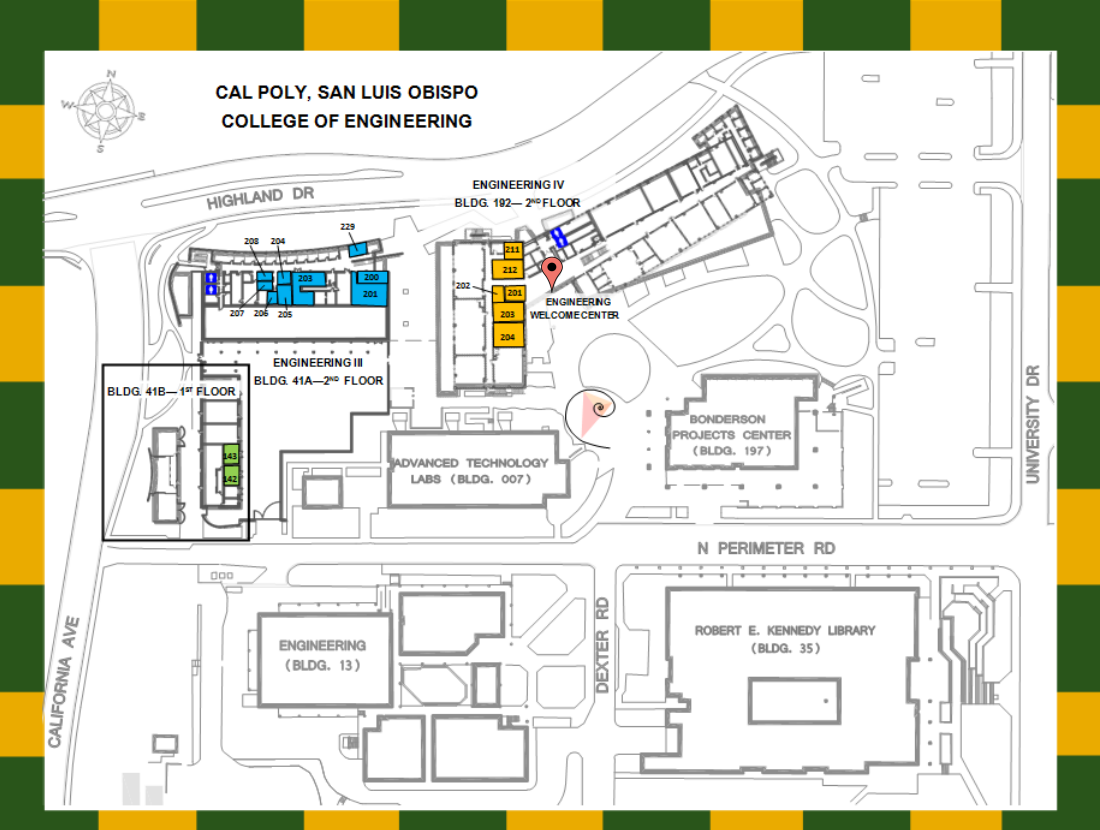
41-142 MATE Shop
Work area with band saws, drill press, and table saw for simple machining.
41-143 Furnace Lab
Furnaces to heat-treat different types of materials; kiln for ceramics.
41-201 MATE 215 Lab
41-204 Sample Prep Lab
41-207 DSC & FTIR Lab
The Fourier Transform Infrared Spectroscopy (FTIR) allows students to identify chemical bonds and functional groups in a material. Differential Scanning Calorimetry (DSC) is used to measure phase changes.
41-208 XRD Lab
Phase identi-fication of crystalline materials by using x-rays to probe atomic arrangements and elemental composition analysis through x-ray fluorescence to determine the presence and concentration of elements.
192-201 Sample Prep Lab
Samples prepped to examine micro structures by sectioning with cut off and precision diamond saws, mounting with epoxy or Bakelite, and grinding specimens towards mirror finish.
192-203 Project Lab
192-210 3-D Printer Lab
3D printers with a variety of filament options alongside a high temperature furnace for materials heat treatment.
192-211 Mechanical Testing Lab
An Instron tester, (which measures mechanical properties such as strength), hardness tester, and accelerated UV and humidity weathering device.
192-212 Metallography Lab
Students polish and etch mounted samples of materials to reveal and image microstructures.
Darkfield and Polarizing Filters for Light Microscopes SOP
DIC Filters for Light Microscopes SOP
Leica DM IRE2 and DM IRB Instructions
Light Microscope Calibration SOP
Phase / Grain Size Measurement With IQ Materials Imaging Software SOP
SEM Lab
This microscope uses electrons, rather than visible light, to image objects in order to get a very high magnification that includes depth of field. Elemental analysis is also possible with energy dispersive spectroscopy (EDS).
